By Tribes Gorilla Trekking Tours | Uganda’s Bush Safari Authority
Reading time: approximately 18 minutes | Word count: 4,200+
Introduction: Why Uganda Is the Gorilla Trekking Capital of the World
There is a moment — and every single person who has experienced it will tell you exactly the same thing — when you push through the last wall of dense green forest, your guide raises a quiet hand to stop you, and there, just a few metres away, a mountain gorilla looks directly into your eyes.
It is not like seeing an animal in a zoo. It is not like watching a nature documentary. It is something that bypasses your brain entirely and goes straight to a place you did not know existed. It is the feeling of recognising something ancient and familiar in a being that shares 98.3% of your DNA. It is, without any exaggeration, one of the most profound experiences available to any human being on this planet.
And the best place in the world to have it is Uganda.
Uganda is home to more than half of the world’s remaining mountain gorillas — approximately 460 of the roughly 880 individuals that survive today. These extraordinary animals live in two locations within Uganda: Bwindi Impenetrable National Park in the southwest, and Mgahinga Gorilla National Park on the border with Rwanda and the Democratic Republic of Congo. Both parks are managed by the Uganda Wildlife Authority (UWA) under one of the most successful conservation programmes in African wildlife history.
At Tribes Gorilla Trekking Tours, we have guided travellers through this experience for years. We know these forests, these gorilla families, and these trails with an intimacy that only comes from doing this every single day. This guide contains everything we have learned — written honestly, in full detail, so that you can plan your gorilla trekking experience with complete confidence.
What Exactly Is Gorilla Trekking?
Gorilla trekking — also called gorilla tracking — is a guided wildlife experience in which a small group of visitors (a maximum of eight people per gorilla family, per day) follows trained rangers and trackers into the forest to locate and spend time with a habituated mountain gorilla family.
The word “habituated” is important. These gorillas have not been tamed or domesticated. They are completely wild animals living entirely on their own terms in their natural habitat. Habituation is a years-long process through which researchers and rangers gradually acclimatise a gorilla family to the presence of humans, until the animals are comfortable enough to go about their normal daily lives — feeding, playing, grooming, resting — without being disturbed by a small group of quiet, respectful human observers nearby.
Once you reach the gorilla family, you are permitted to spend exactly one hour with them. This rule is non-negotiable and exists entirely for the protection of the gorillas. Mountain gorillas are extremely susceptible to human respiratory diseases, and limiting exposure time is one of the key measures that keeps them safe.
That one hour, however, is enough to change you forever.
Mountain Gorillas: Understanding Who You Are Going to Meet
Before you trek, it helps enormously to understand a little about the animals themselves.
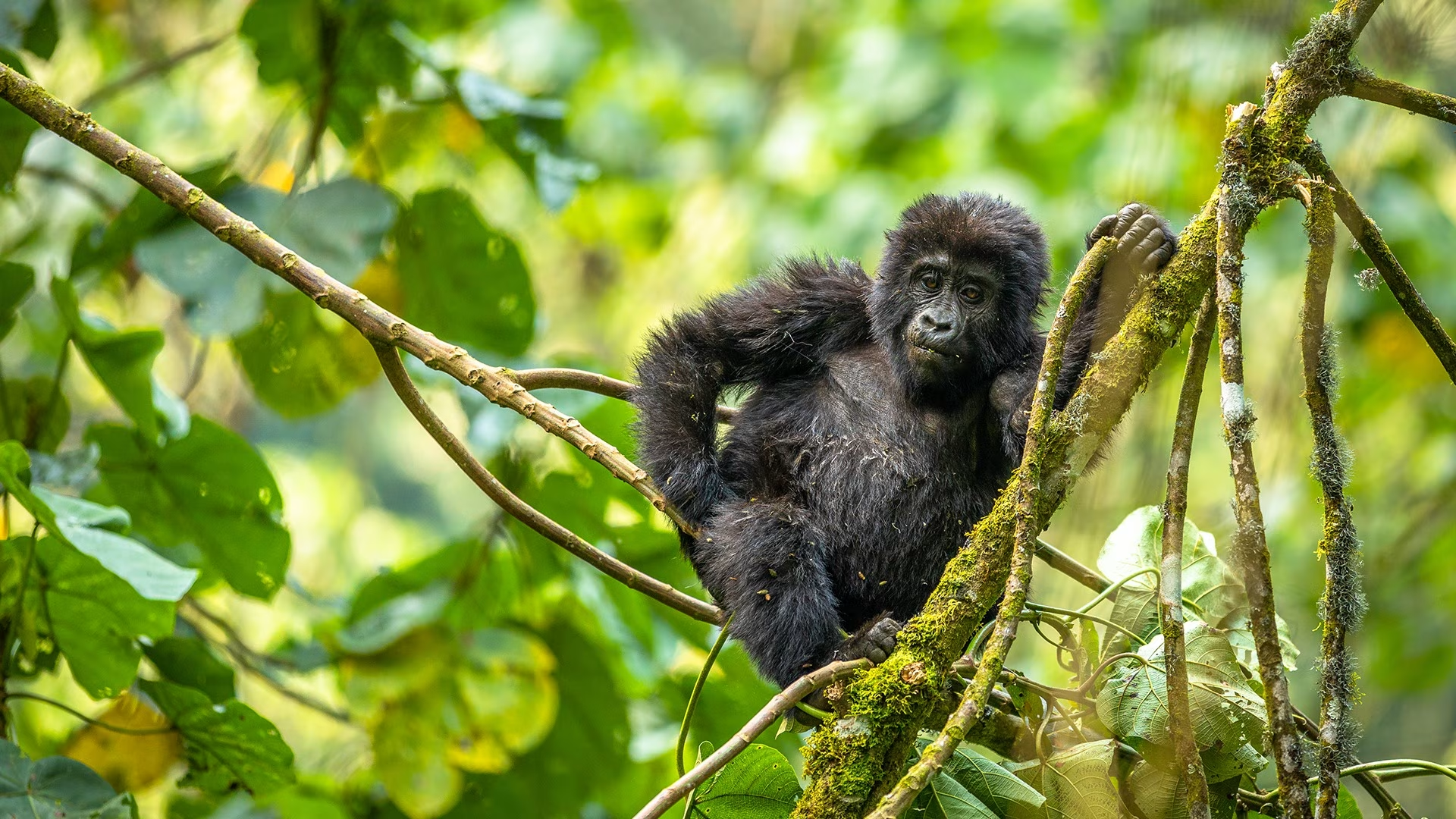
Mountain gorillas (Gorilla beringei beringei) are one of two subspecies of eastern gorilla. They live exclusively in the Virunga volcanic mountains that span Uganda, Rwanda, and the Democratic Republic of Congo, and in Uganda’s Bwindi Impenetrable Forest. They cannot survive in captivity — every mountain gorilla on Earth lives in the wild. This means there are no mountain gorillas in any zoo, anywhere in the world.
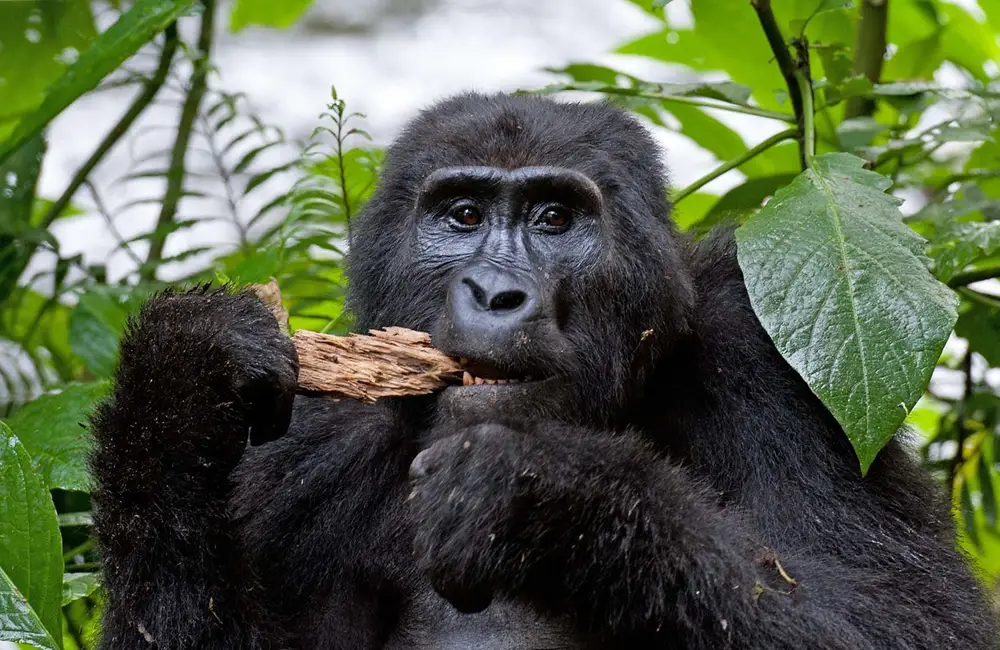
An adult male mountain gorilla — called a silverback because of the distinctive silver-grey hair that develops across his back and hips as he matures — can weigh up to 220 kilograms and stand nearly 1.8 metres tall. Despite their extraordinary physical power, mountain gorillas are predominantly gentle, highly social animals that live in family groups of between five and thirty individuals, led by a dominant silverback.
Their diet is almost entirely vegetarian: leaves, stems, fruit, and bark make up the vast majority of what they eat. A silverback can consume up to 34 kilograms of vegetation in a single day. They build new sleeping nests every night, bending vegetation into a platform either on the ground or in the lower branches of trees.
Mountain gorillas communicate through a rich repertoire of vocalisations, facial expressions, and body language. You may hear deep belching sounds, which indicate contentment. You may see chest-beating, which can signal excitement, display of strength, or alarm. You will almost certainly witness younger gorillas playing — tumbling, chasing, and wrestling with each other — and the sight of a baby gorilla learning to climb while its mother watches patiently is something that will stay with you for the rest of your life.
The conservation story of the mountain gorilla is one of the most remarkable in modern wildlife history. In 1981, the total world population was estimated at just 254 individuals. Decades of dedicated conservation work, community engagement, anti-poaching efforts, and well-managed ecotourism have brought that number to approximately 880 today. The mountain gorilla is the only great ape whose population is currently increasing. Your gorilla trekking permit directly funds this conservation work.
Bwindi Impenetrable Forest vs Mgahinga Gorilla National Park: Which Should You Choose?
Uganda has two parks where gorilla trekking takes place. Understanding the differences will help you make the right choice for your experience.
Bwindi Impenetrable National Park
Bwindi is the premier gorilla trekking destination in the world. This ancient montane rainforest covers 331 square kilometres in southwestern Uganda and has been continuously forested for more than 25,000 years, including through the last ice age — which is why it contains such extraordinary biodiversity.
Bwindi is home to approximately 19 habituated gorilla families spread across four trekking sectors: Buhoma (north), Ruhija (east), Rushaga (south), and Nkuringo (south). This variety means Bwindi can accommodate more trekkers per day than Mgahinga, and also gives travellers the option to select a sector based on accommodation preferences, desired trek difficulty, or specific gorilla family characteristics.
The forest itself is extraordinarily beautiful — dense, layered, ancient, and alive with over 350 species of birds, 120 species of mammals, and more than 1,000 flowering plant species. Trekking through Bwindi feels genuinely primordial. The name “Impenetrable” is not an exaggeration.
Trek difficulty at Bwindi ranges from moderate to very strenuous, depending on the sector and how far the gorilla family has moved that morning. Some treks can be completed in under two hours. Others may take the better part of a day. Your guides will always be honest with you about the expected difficulty when you are briefed the morning before your trek.
Mgahinga Gorilla National Park
Mgahinga is smaller (33.7 square kilometres), less visited, and offers a very different landscape. Situated on the slopes of three of the eight Virunga volcanoes — Mount Gahinga, Mount Sabyinyo, and Mount Muhavura — Mgahinga offers dramatic volcanic scenery that Bwindi does not. The backdrop of these ancient volcanoes rising above the forest is spectacular.
Currently only one gorilla family, the Nyakagezi family, is habituated at Mgahinga. This family has on occasion crossed the border into Rwanda or the DRC, though they spend the majority of their time on the Ugandan side. Because there is only one family, there are fewer permits available per day, which means Mgahinga feels even more exclusive and intimate than Bwindi.
Mgahinga also offers golden monkey trekking — a rare and highly rewarding experience — and volcano hiking, making it an excellent addition to a broader Uganda itinerary.
Our recommendation at Tribes: For first-time gorilla trekkers, we typically recommend Bwindi — specifically the Buhoma or Rushaga sectors — because of the variety of gorilla families, the reliable availability of permits, and the extraordinary quality of the forest. For travellers who want a more exclusive, off-the-beaten-path experience or who are combining a Uganda trip with Rwanda, Mgahinga is a wonderful choice.
The Gorilla Trekking Permit: Everything You Need to Know
The gorilla trekking permit is the single most important logistical element of your gorilla trekking experience. Here is everything you need to know about it.
Current Permit Price
As of 2025, a gorilla trekking permit in Uganda costs USD $800 per person for foreign non-residents. This is the fee set by the Uganda Wildlife Authority (UWA). For foreign residents of Uganda (holding a valid work permit), the cost is USD $700. East African citizens pay UGX 300,000.
Uganda’s permit is significantly more affordable than Rwanda’s, where gorilla trekking permits cost USD $1,500 per person. This price difference — combined with Uganda’s larger gorilla population and greater diversity of national park experiences — makes Uganda the best value gorilla trekking destination in the world.
What Your Permit Includes
Your gorilla trekking permit includes:
- Entry into the national park on your trekking day
- An expert guide and armed ranger escorts throughout the trek
- The full one-hour visit with the gorilla family
- Park conservation fees (your money directly funds gorilla protection)
- Certificate of participation issued after your trek
Your permit does not include transport to and from the park, accommodation, meals, tips for guides, or porters.
How Far in Advance Should You Book?
This cannot be emphasised strongly enough: gorilla trekking permits sell out, often many months in advance, particularly for the peak dry seasons (June–August and December–February). If you have specific dates in mind, you should be thinking about your permit a minimum of three to six months ahead of travel. For peak season travel, booking six to twelve months in advance is advisable.
At Tribes Gorilla Trekking Tours, we handle the entire permit acquisition process on your behalf. This is one of the most valuable things we do for our clients — navigating the UWA permit system, securing your specific sector and date, and ensuring you have a confirmed, legitimate permit in hand well before you travel.
Can Permits Be Cancelled or Refunded?
The Uganda Wildlife Authority has a permit transfer and cancellation policy, but refunds are limited and conditions apply. This is why comprehensive travel insurance — specifically covering permit costs — is strongly recommended for all gorilla trekking visitors. We advise all our clients on this when they book with us.
When Is the Best Time to Go Gorilla Trekking in Uganda?
Gorilla trekking in Uganda is available every single day of the year. The gorillas do not migrate or hibernate, and they can be tracked in all seasons. However, the experience, the comfort, and the logistics differ significantly depending on when you travel.
The Dry Seasons (June–August and December–February)
Uganda’s two main dry seasons are the most popular times to trek, and for good reason. The forest trails are firmer and less slippery. The weather is generally clear and comfortable. Photography conditions are better. And the overall trekking experience tends to be more physically manageable.
June through August is the longest dry season and the busiest period for gorilla trekking in Uganda. Permits are at their highest demand. Accommodation books up quickly. If this is when you want to travel, plan and book very early.
December through February is the shorter dry season and is particularly popular with travellers from the Northern Hemisphere who are escaping winter. The Christmas and New Year period is extremely busy.
The Wet Seasons (March–May and September–November)
Do not underestimate the wet seasons. Gorilla trekking in Uganda’s green seasons has several genuine advantages that experienced travellers increasingly choose them for.
The forest is extraordinarily lush and beautiful — the colours are more vivid, the air is cleaner, and the entire landscape feels more alive. Gorillas are often easier to locate during the wet season because they tend to feed in more open areas where soft vegetation grows abundantly. There are fewer tourists. Accommodation rates are typically lower. And permits are more readily available with shorter advance booking windows.
The practical reality of wet-season trekking is that the trails are muddier, the humidity is higher, and you will very likely get wet. Proper waterproof gear (covered in the packing section below) makes this entirely manageable — and many of our clients who have trekked in both seasons tell us that the wet season trek felt more authentic and immersive.
Month-by-Month Summary
January — Dry, excellent conditions, busy, book early. February — Dry, great conditions, quieter than January. March — Transition to wet, still trekkable, fewer crowds. April — Wettest month, lush forest, very few tourists, great for photographers. May — Still wet but easing, beautiful forest, good value. June — Dry season begins, increasing visitors, superb trekking. July — Peak season, outstanding conditions, book 6–12 months ahead. August — Peak season continues, excellent in every way. September — Transition month, short rains begin, still very good. October — Wetter, similar to April advantages, fewer tourists. November — Gradually drying, good birding, moderate visitor numbers. December — Dry season returns, Christmas busy, excellent conditions.
What to Pack for Gorilla Trekking: The Expert Packing List
Packing correctly for gorilla trekking is not complicated, but it matters. The right gear makes the difference between a comfortable, joyful experience and an exhausting one. Here is what we recommend to every single one of our clients.
Clothing
Long-sleeved shirt and long trousers are mandatory — not optional. The forest is full of stinging nettles, safari ants, thorny vegetation, and insects. Your arms and legs must be covered for the entire trek.
Earth tones are strongly recommended: khaki, olive green, brown, grey. Avoid bright colours and, critically, avoid black and dark blue — these colours attract tsetse flies, which deliver a painful bite.
Lightweight, moisture-wicking fabrics are ideal. You will sweat, regardless of the season. Breathable materials make this far more comfortable.
Bring a light fleece or warm layer. At altitude (Bwindi sits between 1,160 and 2,607 metres above sea level), mornings can be surprisingly cool, and the forest interior is shaded and damp.
A waterproof rain jacket or poncho is essential year-round. Even in the dry season, the forest generates its own moisture and brief afternoon rains are common.
Footwear
Sturdy, waterproof hiking boots with good ankle support are the most important item you will pack. The trails can be steep, muddy, and uneven. Well broken-in boots — not new ones that will cause blisters — are what you want on your feet. Gaiters are an excellent addition, particularly in the wet season, for keeping mud and insects out of your boots.
Essential Daypack Contents
Bring a small, lightweight daypack (20–30 litres is ideal). Inside it, you should carry:
- At least 2 litres of water — you will need it
- High-energy snacks: trail mix, energy bars, fruit
- Your camera equipment (see photography section below)
- A small first aid kit with plasters, antiseptics, and any personal medication
- Sunscreen and insect repellent
- A hat for the approach trails before entering the forest canopy
- Spare socks and a dry layer in a waterproof bag
- Your gorilla trekking permit (keep it accessible)
- Cash for tips
Porters are available at all trekking sectors and we strongly recommend hiring one. For a modest fee (typically USD $15–20 for the day, plus your tip), a porter will carry your daypack, help you through difficult terrain by offering a steadying hand, and enormously reduce the physical effort of the trek. Hiring a porter also directly supports the local communities that live adjacent to the park.
Camera Equipment
A camera with a good zoom lens is ideal — a 100–400mm lens gives you the flexibility to photograph from a respectful distance without needing to move closer to the gorillas. However, do not sacrifice your experience by spending the entire hour staring through a lens. Put it down. Look with your own eyes. The memory you form without a viewfinder in front of it is more vivid and more lasting than any photograph.
Flash photography is strictly prohibited at all times. It startles the gorillas and is a major violation of the trekking rules.
What Happens on Gorilla Trekking Day: A Full Breakdown
Understanding exactly what your trekking day involves will help you feel calm, prepared, and fully present for the experience.
The Night Before
Your guide from Tribes will brief you on the next morning’s logistics: what time to be ready, what to bring, and what to expect. Use this briefing to ask any questions. Get an early night — you will need your energy.
Morning Briefing at the Park Headquarters
All gorilla trekking groups begin with a briefing at the park’s starting point, which typically takes place between 7:00 am and 8:00 am. A park ranger will explain the rules of the trek, introduce you to your specific group and gorilla family, and provide an estimate of how far the gorillas were located the previous evening (rangers track the gorillas every day to identify their nesting site, which tells them roughly where they will be the following morning).
The briefing lasts approximately 30–45 minutes.
The Trek
Your group — a maximum of eight visitors plus guides, rangers, and trackers — enters the forest. The duration of the trek to reach the gorilla family varies enormously: it can be as short as 20 minutes or as long as six hours, depending on how far the gorillas have moved. The average is typically two to four hours of trekking.
During the trek, your guides will educate you about the forest — the trees, birds, plants, and ecology. They will communicate via radio with trackers who have gone ahead to locate the family. When the trackers make contact, your pace will slow, and you will be asked to leave your bags, walking sticks, and any food behind with the porters.
The Visit
You will be asked to stop approximately seven metres from the gorilla family — this is the minimum distance rule. From there, you observe, photograph, and simply exist in the presence of one of the world’s most remarkable animals.
The gorillas will typically ignore you entirely and carry on with their day: eating, moving through the vegetation, grooming one another, and playing. Occasionally, a young gorilla will approach out of curiosity — if this happens, do not reach out to touch it. Stand still, avoid direct eye contact with silverbacks (which can be interpreted as a challenge), and follow your ranger’s quiet instructions.
The hour passes very quickly. Almost everyone we have guided tells us the same thing when it is over: they did not want to leave.
The Return
After your hour, you return through the forest. Your Tribes guide will be waiting to congratulate you, and your certificate of gorilla trekking participation will be presented. Many visitors choose this moment to tip their guides and porters — a gesture that is deeply appreciated and entirely appropriate.
Rules and Gorilla Trekking Etiquette: Non-Negotiable Guidelines
These rules exist entirely to protect the gorillas and must be followed without exception.
Keep a minimum distance of seven metres from the gorillas at all times. Do not approach closer, even if a gorilla approaches you — in that case, step back slowly and calmly.
Do not eat or drink within the presence of the gorillas. Food can transmit disease and will attract their attention in an unpredictable way.
Maintain a maximum group size of eight visitors with any gorilla family at any one time.
Spend a maximum of one hour with the gorilla family, regardless of circumstances.
Do not use flash photography at any time.
Do not make sudden movements or loud noises.
If you feel a cough or sneeze coming, turn away from the gorillas and cover your face completely.
If you are feeling unwell — even with mild cold symptoms — you must disclose this at the morning briefing. In some cases, your trek may be postponed for your protection and for the gorillas’. This is not a decision taken lightly, and Tribes will always help you manage the logistics if this happens.
Do not litter in the forest. Everything you carry in, you carry out.
Physical Fitness: How Fit Do You Need to Be?
This is one of the questions we are asked most frequently, and the honest answer is: more fit than you might assume, but less fit than you might fear.
Gorilla trekking is a physical activity. Even on shorter treks, you will be walking on uneven, sometimes steep terrain for at least an hour in each direction, at altitude, in humidity. You do not need to be an athlete, but you should be able to walk for several hours without significant difficulty.
The most important fitness-related advice we give our clients is this: hire a porter. Even very fit travellers benefit enormously from having someone carry their pack and offer a hand on the steepest sections. For older travellers, those with knee or back issues, or anyone who is not regularly active, a porter is not a luxury — it is what makes the trek possible and enjoyable.
There is no upper age limit for gorilla trekking, and we have successfully guided clients well into their seventies and eighties. Children must be at least 15 years old to participate.
If you have specific health concerns, speak to your doctor before booking and then speak honestly to us. In many years of guiding treks, we have rarely encountered a situation where a committed, well-prepared traveller could not complete the experience.
The Conservation Story: Why Your Visit Matters
Every USD $800 gorilla trekking permit generates funds that flow directly into mountain gorilla conservation. Seventy percent of all park entry fees in Uganda are retained by the Uganda Wildlife Authority for park management, ranger salaries, anti-poaching operations, and gorilla monitoring programmes. A further portion of all fees is distributed to communities living adjacent to the national parks — a critical component of conservation, because communities that benefit economically from gorilla tourism have a direct incentive to protect the gorillas and their habitat.
The mountain gorilla’s population recovery — from 254 individuals in 1981 to approximately 880 today — is one of the great conservation success stories of modern times. It happened because of the coordinated efforts of governments, conservationists, local communities, and the responsible tourism industry. When you trek with Tribes Gorilla Trekking Tours, you are not just having an experience. You are actively participating in and funding the continuation of that success story.
We are deeply committed to responsible, sustainable tourism. We follow all UWA guidelines without exception, we employ local guides and staff, and we actively support community development initiatives in the areas where we operate.
Why Book Your Gorilla Trek with Tribes Gorilla Trekking Tours?
Many companies offer gorilla trekking in Uganda. Here is why Tribes Gorilla Trekking Tours consistently delivers the best experience.
We are specialists, not generalists. Gorilla trekking and bush safari experiences in Uganda are what we do — not one offering among dozens. Our entire focus, expertise, and passion is concentrated here.
We handle your permits. Securing gorilla trekking permits from the Uganda Wildlife Authority requires navigating a specific process, paying in advance, and booking far ahead. We manage this entirely on your behalf, so you arrive knowing everything is confirmed.
Our guides are extraordinary. Our trekking guides and bush rangers are experienced, certified, passionate, and deeply knowledgeable about the forests, the gorilla families, the wildlife, and the ecology of Uganda’s national parks. They are also excellent company on a long trail.
We offer the full Uganda bush experience. Gorilla trekking is the centrepiece of what we do, but it sits within a full portfolio of extraordinary experiences: bush breakfast in the savannah, sundowner drinks at golden hour, candlelit bush dinners under the stars, bush picnics in secret wilderness locations, and our signature Top of Murchison Falls Luncheon — a fully catered meal at the apex of the world’s most powerful waterfall. No one else in Uganda does what we do.
We are personal. Every inquiry and every booking is handled by our team directly. You are not a booking reference — you are a guest, and we treat you accordingly from the first message to the final farewell.
How to Book Your Gorilla Trekking Experience
Booking your gorilla trek with Tribes Gorilla Trekking Tours is simple.
Contact us with your preferred travel dates, the number of people in your group, and any specific interests or requirements you have. We will respond personally with availability, permit options, suggested itineraries, and a full, transparent quote. From there, we handle everything.
Email us: info@tribesgorillatrekkingtours.com
WhatsApp us: +256 757 291 063
We respond to every inquiry personally and promptly. We are available seven days a week.
Frequently Asked Questions
Is gorilla trekking safe? Yes. Mountain gorillas that have been habituated to human presence are calm and accustomed to visitors. Professional armed rangers will accompany your trek at all times. The risks of gorilla trekking are negligible compared to the precautions that are in place.
Can children do gorilla trekking? Children must be a minimum of 15 years old to participate in gorilla trekking. The Uganda Wildlife Authority sets this rule and is non-negotiable.
What if the trek takes much longer than expected? It happens occasionally, and it is simply part of the adventure. Your guides will ensure you are comfortable and informed throughout. The gorillas are always found — rangers track them every single day.
What if I feel unwell on trekking day? Disclose any illness at the morning briefing. If you have respiratory symptoms, your trek may need to be postponed. Tribes will help you manage any rescheduling.
Do I need travel insurance? Yes, without question. Comprehensive travel insurance that covers gorilla permit costs, emergency medical evacuation, and trip cancellation is strongly recommended for all visitors.
How many people will be in my trekking group? A maximum of eight visitors per gorilla family per day. Your group may be smaller — private and exclusive group bookings are available through Tribes.
What currency do I need in Uganda? The Ugandan Shilling (UGX) is the local currency. US Dollars are widely accepted for major purchases, permit fees, and accommodation. Cards are accepted at many lodges but cash is advisable for tips, local purchases, and smaller establishments.
Conclusion: The Experience That Changes Everything
There is a reason that experienced travellers — people who have been to dozens of countries, who have seen the Serengeti, the Amazon, and the Himalayas — describe gorilla trekking in Uganda as the single greatest wildlife experience of their lives.
It is because nothing else comes close to the feeling of sitting quietly in an ancient forest, seven metres from a 200-kilogram silverback who is not looking at you as a threat, or a curiosity, or an intrusion — but simply as another living creature sharing the same green world.
Uganda is calling. The forest is ready. The gorillas are there, living their extraordinary lives, waiting — though they do not know it — to give you the hour that you will describe to everyone you love for the rest of your life.
Book your experience with Tribes Gorilla Trekking Tours today.
Email: info@tribesgorillatrekkingtours.com WhatsApp: +256 757 291 063
Published by Tribes Gorilla Trekking Tours — Uganda’s leading bush safari and gorilla trekking specialists. Operating across Bwindi Impenetrable Forest, Murchison Falls National Park, Queen Elizabeth National Park, Kidepo Valley National Park, and Lake Mburo National Park.