
You have decided to go gorilla trekking. You have read about mountain gorillas, looked at the photographs, and something in you has resolved that this is the experience you are going to have—the one hour in an ancient forest with one of the world’s most extraordinary animals that everyone who has done it describes as the single greatest wildlife encounter of their life.
Now comes the decision most travellers face almost immediately: Uganda or Rwanda?
Both countries share the Virunga mountain ecosystem, home to the mountain gorilla. Both offer habituated gorilla families you can visit on guided treks. Both have invested significantly in conservation and tourism infrastructure. And both deliver experiences that are genuinely extraordinary.
But they are not the same experience. They are not the same value proposition. And for most travellers—depending on what you are looking for, what you are willing to spend, and how you want to structure your broader Africa trip—one of them is the right choice and the other is less optimal.
This guide gives you the most honest, detailed, and complete comparison of gorilla trekking in Uganda and Rwanda for 2027/2028, so you can decide with full information and complete confidence.
The Fundamental Facts: Mountain Gorillas in Both Countries
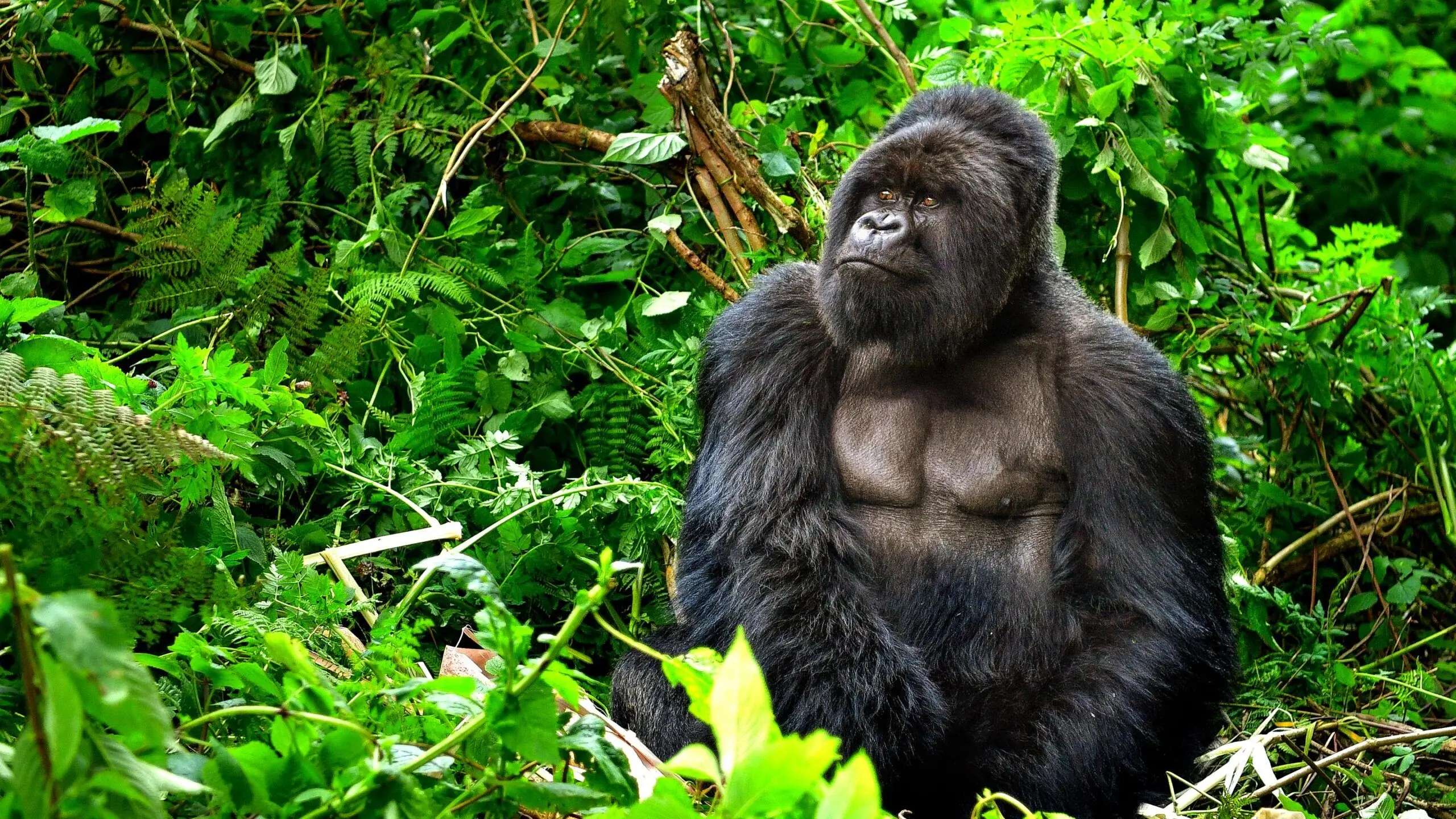
Mountain gorillas—Gorilla beringei beringei—live in two separate locations. The larger population, approximately 460 individuals, lives in and around Bwindi Impenetrable National Park in Uganda. The second population, approximately 420 individuals, lives in the Virunga mountain range, shared between Uganda’s Mgahinga Gorilla National Park, Rwanda’s Volcanoes National Park, and the DRC’s Virunga National Park.
Every mountain gorilla on Earth lives in the wild. There are none in captivity. Both the Uganda Wildlife Authority (UWA) and Rwanda Development Board (RDB) manage trekking with strict rules, limited permit numbers, and conservation fees built into the permit price. Whatever country you choose, your permit fee funds the survival of one of the world’s most endangered animals.
The Permit Price: The Single Biggest Practical Difference
This is the most immediately obvious difference, and for many travellers it is the factor that most directly shapes the decision.
Uganda 2027/2028 Permit Pricing:
- High season (January–March, June–October, December): $800 USD per person for foreign non-residents
- Low season (April, May, November): **$600 USD** per person—a $200 saving
- Gorilla Habituation Experience (4 hours): $1,500 USD**, rising to **$1,800 USD from January 1, 2027
Rwanda 2027 Permit Pricing:
The difference is $700 per person** ($800 Uganda vs $1,500 Rwanda) in high season, or **$900 per person if you travel Uganda’s low season ($600 vs $1,500).
For a couple trekking together, that is $1,400–$1,800 in permit savings alone. For a group of eight (the maximum per gorilla family), the difference reaches $5,600–$7,200.
Critical 2027 update: As of March 1, 2026, UWA eliminated unpaid reservation holds. All permits now require full payment at the time of booking. There is no provisional holding period. You must confirm your travel dates with certainty before proceeding.
For budget-conscious travellers, families, and groups, Uganda is the clear choice on permit cost alone. For travellers for whom the cost difference is genuinely irrelevant, the permit price drops out, and other factors become decisive.
The Gorilla Families: Variety vs Exclusivity
Uganda: Greater Variety and Availability
Uganda has a substantially larger number of habituated gorilla families. Bwindi alone has 25 habituated families (9 open to tourism) across four sectors—Buhoma, Ruhija, Rushaga, and Nkuringo—plus Mgahinga’s single Nyakagezi family. This gives Uganda considerably greater daily permit capacity and better availability, even for peak season dates.
For travellers with specific date requirements, shorter lead times, or larger groups needing multiple permits on the same date, Uganda’s family diversity is a significant practical advantage.
Rwanda: Fewer Families, More Competition
Rwanda’s Volcanoes National Park has approximately 10 habituated families, with a maximum of 8 permits per family per day. This smaller capacity means Rwanda permits—particularly in peak season—are more difficult to secure and require longer booking windows.
The Trekking Experience: What Is Actually Different on the Day?
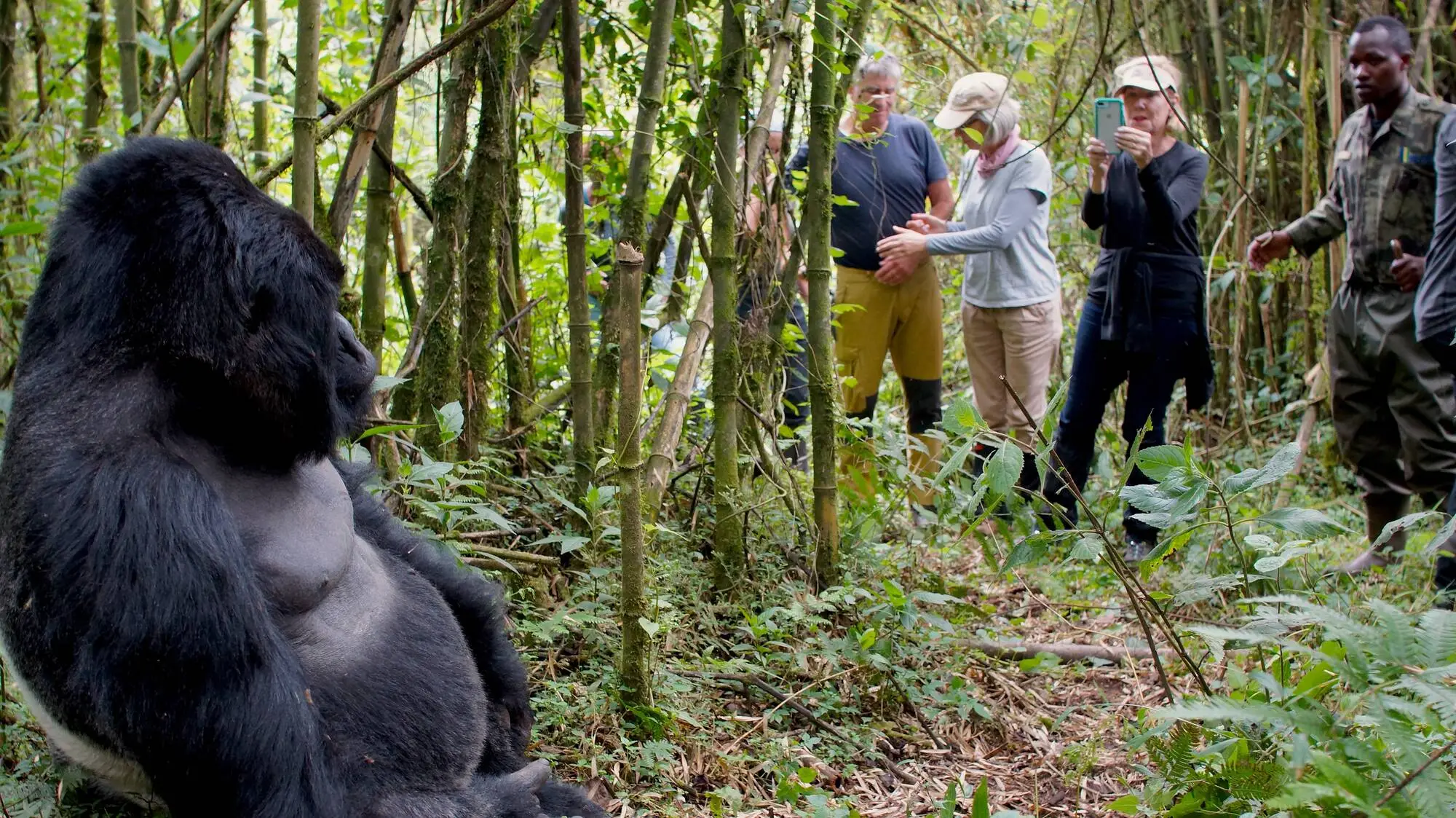
Both countries offer the same fundamental experience: a guided trek to locate a habituated gorilla family, followed by a one-hour visit under ranger supervision. The rules are essentially identical: maximum 8 visitors per family, minimum 7–10 metres distance, no flash photography, strict one-hour limit.
Where the experiences diverge is in the environment.
Bwindi Impenetrable Forest is an ancient lowland and montane rainforest—dense, layered, and profoundly atmospheric. Bwindi has been continuously forested for over 25,000 years, and the antiquity of the ecosystem communicates itself through the density of vegetation and extraordinary biodiversity. Trekking here feels immersive and enveloping in a way that is distinctive to this ancient forest.
Rwanda’s Volcanoes National Park offers montane bamboo and Hagenia woodland on the slopes of the Virunga volcanoes—beautiful and dramatic, particularly on higher slopes where bamboo gives way to open moorland. The volcanic landscape gives the Rwanda trek a more open, vertically dramatic character.
Neither is objectively better. They are different landscapes with different qualities.
Trek Duration: Rwanda’s treks are generally described as somewhat shorter on average, with the RDB matching group fitness levels to family difficulty. Uganda’s Bwindi treks—particularly Ruhija and Nkuringo sectors—can be longer and more physically demanding, though Buhoma and Rushaga offer more moderate options. Uganda offers porter hire at all sectors ($15–$20), significantly reducing the physical challenge.
The Gorilla Habituation Experience: Uganda Only
Uganda offers a four-hour visit with a gorilla family still being habituated to human presence, conducted alongside researchers and rangers. Available in Rushaga sector, this allows a maximum of four visitors to spend four times as long with a gorilla family as the standard trek. The permit costs $1,500 USD** (rising to **$1,800 USD from January 1, 2027). For travellers wanting the deepest possible gorilla encounter, this offers something Rwanda simply does not have.
The Broader Safari Experience: Uganda’s Decisive Advantage
This is where the comparison shifts most decisively in Uganda’s favour—and where the case for Uganda becomes most compelling for any traveller wanting more than a single gorilla trek.
Uganda’s National Park Portfolio
Murchison Falls National Park—Uganda’s largest and oldest park, home to the world’s most powerful waterfall, one of East Africa’s largest elephant populations, enormous Nile hippo concentrations, Rothschild’s giraffe, lion, leopard, and over 450 bird species—has no equivalent in Rwanda.
Queen Elizabeth National Park—Uganda’s most biodiverse protected area, with over 600 bird species, tree-climbing lions in Ishasha, the Kazinga Channel hippo population, and chimpanzees in Kyambura Gorge—is a destination a week of dedicated visiting does not exhaust.
Kibale National Park contains the highest density of primates of any forest in Africa, offering chimpanzee trekking experiences among the finest in the world. Uganda has approximately 5,000 chimpanzees, with habituated communities available in Kibale, Budongo, Kyambura, and elsewhere.
Rwanda, by contrast, is approximately the size of Wales. Volcanoes National Park is exceptional for gorilla trekking, and Akagera offers good savannah viewing, but the breadth, scale, and ecological variety of Uganda’s park system cannot be matched. Rwanda does not have habituated chimpanzees available for trekking within its national parks.
For any traveller wanting to combine gorilla trekking with a broader East African safari experience, Uganda is comprehensively the better choice.
Practical Considerations: Logistics and Accessibility
Getting There
Both countries have international airports—Entebbe (EBB) in Uganda, Kigali (KGL) in Rwanda—with flights from major hubs. Rwanda’s Kigali is compact and modern, with Volcanoes National Park just a 2.5–3-hour drive from the airport. Uganda’s Bwindi is an 8–9 hour drive from Entebbe, or a 1-hour domestic flight to Kihihi or Kisoro.
Accommodation
Rwanda has invested heavily in high-end tourism infrastructure, and luxury lodges near Volcanoes National Park are among the finest in East Africa. Uganda’s accommodation has improved significantly, with excellent luxury lodges now operating in all four Bwindi sectors. The gap has closed considerably, and Uganda offers a wider range of mid-range and budget options.
Overall Cost
Rwanda has positioned itself as a premium destination across its entire value chain. A Rwanda gorilla trekking experience is more expensive than an equivalent Uganda experience across almost every cost category. For budget-conscious travellers, the total difference can amount to several thousand dollars per person over a standard itinerary.
Who Should Choose Rwanda?
- Travellers combining a gorilla trek with a broader Rwanda experience—the genocide memorial, cultural sites—for whom the trek is one component of a Rwanda-focused trip
- Travellers with very limited time (5–7 days) who want minimal transit time and maximum comfort
- Travellers for whom permit cost is genuinely irrelevant and who want Rwanda’s reputation as Africa’s most luxurious gorilla destination
- Travellers wanting to combine gorillas with golden monkey trekking and volcano hikes in a compact, well-managed park
Who Should Choose Uganda?
- Any traveller wanting to combine gorilla trekking with a broader East African safari—Bwindi, Queen Elizabeth, Murchison Falls, and Kibale create an itinerary Rwanda cannot replicate
- Travellers for whom the $700–$900 per person permit saving is meaningful
- Travellers who want to trek chimpanzees as well as gorillas
- Travellers drawn to the Gorilla Habituation Experience
- Travellers who value authenticity, rawness, and genuine wilderness over polish and premium branding
Booking Strategy for 2027/2028
Peak season (June–September, December–February): Start 6 to 12 months ahead. Popular dates and sectors sell out months in advance.
Low season (April, May, November): A few months ahead is usually sufficient, though earlier is safer. Uganda’s $600 low-season permit offers significant savings, but these permits are date-fixed and non-reschedulable.
Rwanda: For June–September 2027, book by February 2027. For December/January dates, book by April or May 2027.
Avoid Permit Scams: Only pay through official channels or a licensed operator you have verified. Be wary of anyone offering “guaranteed” permits on the day, very cheap permits, or payment to a personal account.
Our Honest Final Verdict
If you are a first-time gorilla trekker who wants the most complete, varied, and extraordinary African experience available within a reasonable budget, Uganda is your destination.
If you have an unlimited budget, very limited time, and a specific interest in Rwanda beyond its gorilla population, Rwanda is a genuinely excellent choice.
If you have the time to combine both—flying into Kigali, trekking in the Virungas, crossing to Uganda for Bwindi, then continuing to Queen Elizabeth and Murchison Falls—you will experience the most complete version of what this extraordinary corner of Africa offers.
But if you are asking us directly: Uganda. The combination of lower permit costs, greater gorilla family variety, a richer national park portfolio, more diverse wildlife experiences, and the option of the four-hour Habituation Experience creates a total package that Rwanda, for all its genuine excellence, cannot match.
Uganda is more. More wildlife. More parks. More variety. More wilderness. More experience per dollar spent.
Plan Your Uganda Gorilla Trekking Experience
At Tribes Gorilla Trekking Tours, we design every Uganda itinerary personally—around your dates, interests, fitness level, budget, and the specific combination of experiences that will make your time in Uganda the journey of a lifetime.
We secure your gorilla permits before they sell out, arrange domestic flights and road transfers, book accommodation across every park, and integrate signature experiences into every itinerary.
Contact us today to check availability for your preferred 2027/2028 dates and receive a tailored itinerary combining gorilla trekking with the best of East Africa.
Email: info@tribesgorillatrekkingtours.com
WhatsApp: +256757291063
We respond personally to every inquiry, seven days a week.
Tribes Gorilla Trekking Tours is a fully licensed Ugandan tour operator registered with the Uganda Tourism Board and the Association of Uganda Tour Operators. We operate across Bwindi Impenetrable National Park, Mgahinga Gorilla National Park, Murchison Falls National Park, Queen Elizabeth National Park, Kidepo Valley National Park, and Lake Mburo National Park.