
My First Gorilla Trekking Experience in Bwindi: A Day I Will Never Forget
By Tribes Gorilla Trekking Tours | Uganda’s Gorilla Trekking Specialists
Reading time: approximately 16 minutes | Word count: 3,200+
Before We Begin: A Word About This Post
Most travel writing about gorilla trekking describes the experience from the outside. It lists the facts, explains the logistics, and tells you what to expect in the measured, organised language of a guide.
This post does something different.
This is a first-person account of what it actually feels like to trek for mountain gorillas in Bwindi Impenetrable Forest — written the way our clients describe it to us when they come back down the mountain, still slightly dazed, still processing what has just happened to them. It is written for the person who is sitting at their desk, or lying in bed at night, or scrolling through photographs of Uganda, wondering whether this experience is really as extraordinary as everyone says it is.
It is. It is more.
Here is what a gorilla trekking day with Tribes Gorilla Trekking Tours in Bwindi Impenetrable National Park actually looks and feels like, from the moment you wake up to the moment you walk back into the world carrying something inside you that was not there before.
4:45am: The Alarm Goes Off in the Dark
The lodge is quiet. Through the window of your room, the forest is a wall of absolute darkness and the sounds coming from it — the distant hoot of a bird, something moving in the undergrowth, the steady breathing of a forest at rest — are already telling you that today is different from any other day you have planned.
You dressed last night. The clothes are laid out on the chair: the long-sleeved khaki shirt, the hiking trousers, the thick socks pulled over the trouser hems, the gaiters clipped and ready. You put the boots on in the dark, already broken in, already familiar. You pour hot water from the flask the lodge left outside your door into a cup and drink it standing up, looking out at nothing.
Your stomach has the particular lightness of the morning of something important.
5:30am: The Drive to the Park
The vehicle — a sturdy four-wheel drive with your Tribes guide at the wheel — moves through the darkness along a road that is more suggestion than surface. The headlights pick out red soil, overhanging vegetation, the occasional pair of eyes at the roadside that your guide identifies without slowing down: a bushbuck, a genet, a forest robin on a low branch.
You do not talk much. The darkness and the earliness and the sense of something approaching makes conversation feel unnecessary. Your guide, who has done this hundreds of times, knows this and leaves you to your thoughts.
As the sky begins to lighten — not sunrise yet, just the first grey dilution of darkness — the outline of the forest appears above the road, rising steeply, impossibly dense, blocking the sky completely along the ridge. This is Bwindi. You are looking at a forest that has been standing, growing, and sheltering life for more than twenty-five thousand years.
Somewhere up there, in a nest of bent vegetation on the forest floor or in the low branches of a tree, a mountain gorilla family is sleeping. They do not know you are coming. In a few hours, they will not care.
7:15am: The Morning Briefing
The briefing takes place at the park headquarters — a simple clearing with a thatched shelter, a noticeboard with photographs of the gorilla families, and a group of people from different countries who are all, in this moment, united by the same nervous anticipation.
Your ranger — a compact, quietly confident man who has been working with the gorillas of this sector for over a decade — begins the briefing with the rules. Not aggressively, not bureaucratically, but with the patient clarity of someone who understands exactly why the rules exist and wants you to understand it too.
Stay at least seven metres from the gorillas at all times. Do not eat or drink in their presence. No flash photography under any circumstances. If a gorilla approaches you, stand still, do not make direct eye contact with the silverback, and follow instructions immediately. You have one hour with the family. When the time is called, it is called.
Then he tells you about your family. He shows you a laminated photograph — a chart of the family members, their names, their relationships to one another, their individual characteristics. He tells you about the dominant silverback, how old he is, what his personality is like. He tells you about a young female who has recently given birth, about a juvenile male who has been getting increasingly bold and curious with visitors. He speaks about these animals the way you might speak about neighbours you have known for years.
You study the photographs and realise something: these are not anonymous wildlife. These are specific individuals with histories and personalities and relationships. You are not going to see a gorilla. You are going to meet a family.
The eight of you — the maximum group size, though today you are only six — are assigned a porter each. Yours is a young man with extraordinary energy and a smile that does not waver once during the entire day. He takes your daypack without ceremony and settles it onto his back alongside his own small bag as though it weighs nothing. You will be deeply, sincerely grateful for this decision within the first twenty minutes of the trek.
8:00am: Into the Forest
The forest begins not gradually but immediately. One step takes you from the open clearing at the park boundary into a world so different from the one you just left that the transition feels almost physical — a change in pressure, in temperature, in the quality of the air itself.
The canopy closes overhead. The light drops and shifts into something green and diffuse and ancient. The sounds change: the distant noise of the road and the other vehicles vanishes as completely as if a door has been closed, replaced by birdsong from every direction and every elevation, the sound of water moving somewhere below, the creak and settle of enormous trees.
The trail rises immediately. Steeply. Your boots find their grip in the red earth and your trekking poles — borrowed from the park station because you forgot your own — plant themselves and pull you forward. Your porter is three steps ahead of you, carrying your pack as though he is strolling through a park, occasionally turning to offer a hand at the steeper sections with a matter-of-factness that makes you feel simultaneously grateful and humbled.
The vegetation on either side of the trail is extraordinary. Giant tree ferns arc overhead. The forest floor is a deep green carpet of mosses, herbs, and low plants through which the trail cuts a narrow path. Stinging nettles line the edges — your guide warned you about these at the briefing, and now you understand exactly what he meant. The long sleeves are not optional. They are what stands between you and a morning of burning, itching misery.
Your ranger moves at a pace that is unhurried but purposeful. He stops occasionally to listen, to look, to speak quietly into his radio to the tracker team that has gone ahead at first light to find where the family has moved overnight. You hear crackling responses that you cannot interpret. The ranger nods, adjusts your direction slightly, and continues.
You are not thinking about your desk at work. You are not thinking about your phone, which is in your pack. You are thinking about nothing except the forest in front of you, the sound of your breathing, and what might be waiting around the next bend in the trail.
9:45am: The Radio Crackles
You have been walking for about an hour and forty minutes. The trail has levelled slightly and you have entered a section of the forest where the trees are larger and older, their roots rising from the ground like the buttresses of cathedrals. The light is dimmer here and the air cooler.
The ranger’s radio crackles. He stops. Listens. Speaks a few words. Then he turns to the group with an expression that is professionally calm but contains, if you look carefully, something that looks very much like satisfaction.
They have found them.
He tells you to leave your walking sticks and any food with the porters. He tells you again, quietly, about the seven-metre rule. He tells you that you may hear the gorillas before you see them. He adjusts the group into a single file and you move, now more slowly, off the trail and into the vegetation.
The undergrowth is denser here. You are pushing through leaves, stepping over roots, ducking under branches. Your ranger is perhaps five metres ahead of you, moving with a silence that you are nowhere close to matching. Every step you take sounds enormous to you. You are very aware of your own breathing.
Then you hear it.
A sound that is somewhere between a cough and a bark, deep and resonant, coming from your left. Then the sound of something moving through vegetation — large, unhurried, completely untroubled. Then a series of soft vocalisations that you will later learn are contentment calls: low, rhythmic belches that mean everything is well, that the family is at ease, that this is just another morning in the forest.
Your ranger raises his hand and you stop.
9:52am: The First Sighting
She is perhaps eight metres away, sitting with her back partially toward you, pulling a stem of vegetation toward her with one hand and stripping the leaves with the other with a casual dexterity that is simultaneously utterly animal and startlingly familiar. She is an adult female, probably twelve or thirteen years old based on her size, and she is doing exactly what she would be doing if you were not there: eating breakfast.
She glances at you. One look, calm and assessing, and then she returns to her eating.
Nobody in your group says anything. Nobody moves. The ranger watches the group and the gorilla simultaneously, a quiet vigilance that is completely unobtrusive.
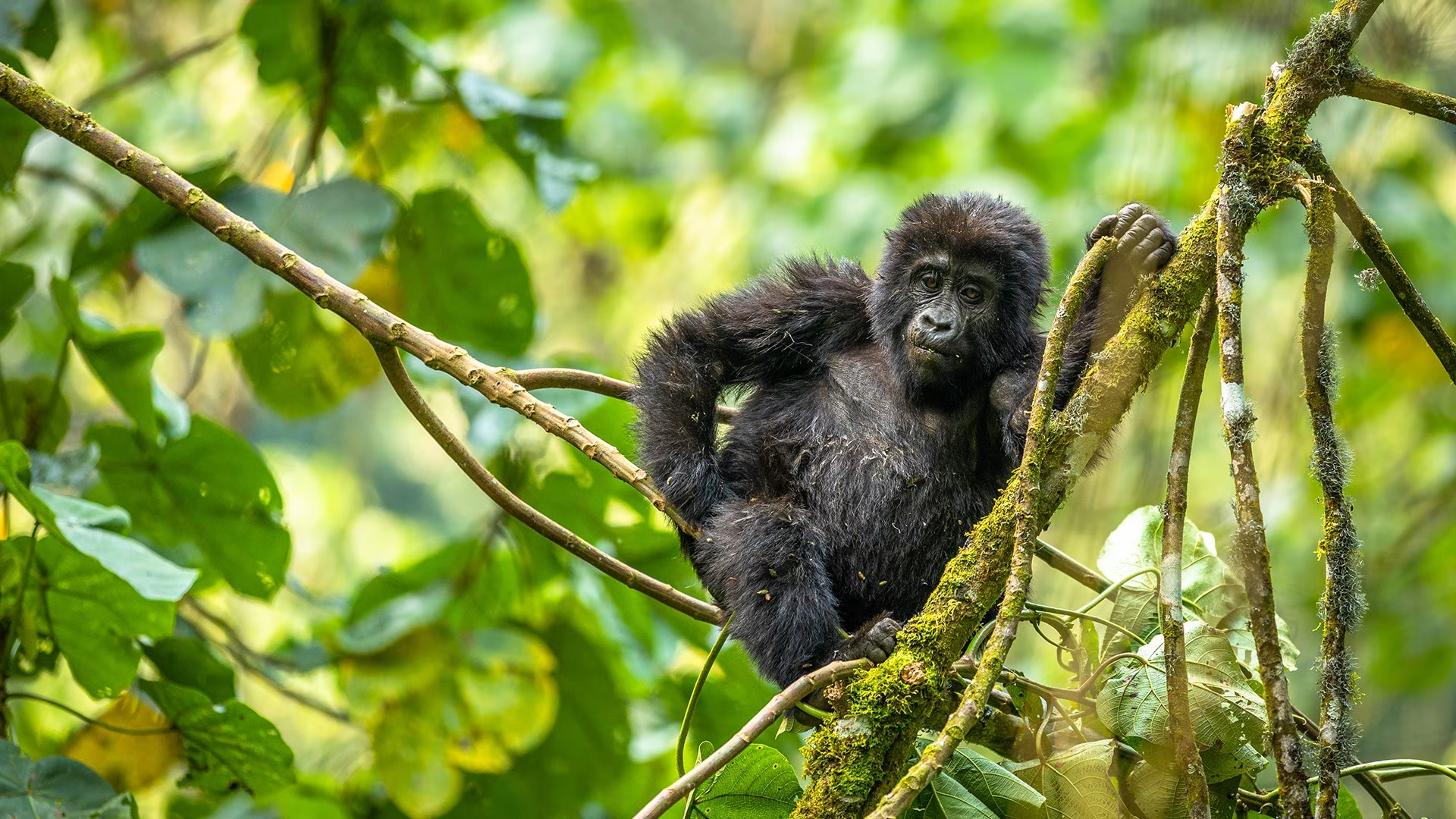
Then, from behind a screen of leaves to the right, a juvenile appears. He is perhaps four years old — the size of a very large dog but shaped like a small person — and he is watching you with an expression of absolute, shameless curiosity. He takes two steps closer. Stops. Takes one more step. Your porter, standing beside you, suppresses a laugh at the animal’s audacity.
The juvenile turns and vanishes back into the vegetation, then reappears three metres to the left. He is circling you. He wants to know what you are. He is deciding whether you are interesting enough to approach.
10:00am: The Silverback
You hear him before you see him.
The sound is a deep, percussive rumble — not aggressive exactly, but authoritative in a way that is impossible to describe. It is a sound that seems to come from the ground as much as from any specific direction, and it silences every other sound around it completely.
The vegetation parts and the silverback moves into the open.
He is enormous. Not enormous in the way that photographs prepare you for — photographs do not prepare you for this. He is enormous in the way that makes your body register something ancient and instinctive, a recalibration of scale and presence that happens below the level of conscious thought. Two hundred kilograms of mountain gorilla, moving with a fluid, rolling gait through his forest, and you are eight metres away from him with nothing between you.
He sits. He looks in your direction — not at you specifically, but in your direction, the way you might glance toward a window. Then he begins to eat.
The silver hair across his back and hips catches what little light penetrates the canopy and turns it into something that glows softly. His hands — enormous, five-fingered, unmistakably hands — work the vegetation with a precision and gentleness that is extraordinary given their size. His face, when he turns slightly, carries an expression that is impossible to read but impossible to look away from.
You think: this is the most powerful living creature I have ever been close to. And: he is completely, utterly at ease.
10:00am to 11:00am: The Hour
What happens in the hour itself is difficult to describe in sequence because it does not feel like sequence. It feels like one sustained, uninterrupted moment.
The family moves around you, which is to say: you are not watching animals in a fixed location. The gorillas move through their forest — eating, resting, grooming one another, playing — and you move with them, always at the regulated distance, always led by your ranger, always watching.
At one point the juvenile male — the curious one — climbs a tree directly above you and sits on a branch looking down at your group with an expression that can only be described as smug. Your ranger watches him carefully, ready to move the group if he decides to descend, but he simply sits there for several minutes, examining you all from his superior vantage point, before swinging down and disappearing into the undergrowth.
At another point, a mother with a very young infant passes within five metres of you — closer than the rules allow, but gorillas do not read the rules and your ranger simply keeps the group still and calm. The infant, clinging to its mother’s chest, is perhaps three months old. It grips her fur with hands that are perfectly formed, miniature, impossibly delicate. The mother moves past you without breaking stride, her eyes forward, completely unbothered.
You take photographs. You forget to take photographs. You stand and simply watch. You realise at some point that you have been holding your breath and make a conscious effort to breathe normally.
The silverback rests for a long period — lying on his side, one arm folded under his head, eyes half-closed. He looks, in this moment, like every large male you have ever seen asleep on a sofa on a Sunday afternoon. The thought arrives and you almost laugh out loud and then you understand: this is exactly what the experience does. It removes the distance. It shows you the continuity. It makes the ninety-eight percent of DNA that you share with this animal not an abstract genetic statistic but a lived, felt, obvious truth.
11:00am: The Time Is Called
The ranger says the word quietly. Time.
Nobody moves immediately. It takes a moment to accept that the hour is over, that this is what ending feels like, that you are being asked to leave a place you have only just arrived at in the truest sense of the word.
You take one more look. The silverback has not moved. The juvenile is somewhere in the undergrowth. The family continues its morning exactly as it will continue its afternoon and its evening and its night — feeding, resting, playing, moving slowly through its ancient forest, entirely sufficient, entirely complete, needing nothing from you or from any human being.
You turn and follow the ranger back through the vegetation.
The Walk Back
The return trek is different from the approach in ways that are hard to articulate precisely.
The physical effort is the same or greater — you are tired now, and the descent to some trekking areas is steep and unrelenting on the knees. Your porter is as patient and steady as he was at the beginning, and you are as grateful for his presence as you were in the first half-hour.
But the interior experience is different. The approach was full of anticipation, of energy directed toward something ahead. The return is full of something that has no single name — not quite peace, not quite happiness, not quite sadness that it is over. A quiet fullness. An expanded sense of what is possible in a single day on this earth.
Your group walks mostly in silence. Someone in front of you stops briefly to take a photograph of a beam of light falling through the canopy onto a tree fern below. You stop too and look at it. It is extraordinarily beautiful. You are not sure you would have noticed it on the way in.
Back at the Starting Point: The Certificate
Your Tribes guide is waiting at the park headquarters with cold drinks, congratulations, and your gorilla trekking certificate — a formal document confirming the date, the park, the gorilla family, and your participation. It is a small piece of paper that will become one of the most meaningful things in your possession.
You tip your ranger guide and your porter. You do this without any awkwardness because you mean it completely. These men gave you the morning. The ranger’s expertise and calm authority made it safe and profound. Your porter’s physical support and quiet company made it possible in a way it might not have been without him. Whatever amount you give feels inadequate to the experience.
You take a photograph with both of them. You exchange details. You mean it when you say you will come back.
That Evening: What Settles In
It is only later — over dinner at the lodge, with a cold Nile Special beer and the sounds of the forest around you and the stars beginning to appear above the canopy — that you begin to understand what the day has done to you.
It has not simply given you an experience. It has reorganised something.
You think about the silverback lying in the forest, eyes half-closed, completely at peace. You think about the infant’s hands on its mother’s fur. You think about the juvenile circling your group with his unselfconscious curiosity, deciding whether you were worth his attention.
You think about the fact that these animals — 880 of them, the last mountain gorillas on Earth — are alive because human beings chose to protect them. Because permits were sold and rangers were trained and communities were supported and poachers were stopped and forests were preserved. Because the complex, imperfect, ongoing effort of conservation continued year after year, decade after decade, even when it was hard and expensive and uncertain.
And you think about the fact that your presence today — your permit, your park fees, your lodge nights, your guide’s salary — is part of that effort now. You are not a spectator of conservation. You are, in a small but real way, part of what keeps this going. Bwindi vs Mgahinga
That is not a small thing. That is, in fact, quite a large thing to carry home with you.
Is Gorilla Trekking Worth It?
People ask us this question more than almost any other. permit cost
Is it worth the permit cost? Is it worth the long flight and the long drive and the early morning and the physical effort? Is it really as extraordinary as everyone says?
We have guided this experience for many years. We have watched hundreds of people walk back out of that forest. And we have never — not once — heard anyone say that it was not worth it.
What we hear, consistently, from people of every age and background and level of travel experience, is some version of the same thing: I did not know it would be like that. I was not prepared for how it would make me feel. I need to come back.
That is not marketing language. That is what people actually say. packing list
The gorillas are real. The forest is real. The encounter is real. And what it does to you — the specific, particular shift in perspective that comes from spending one hour in the presence of a mountain gorilla family in their wild, ancient forest — is more real than almost anything you will experience in a lifetime of travel.
Come and find out for yourself.
Book Your Gorilla Trekking Experience with Tribes Gorilla Trekking Tours
At Tribes Gorilla Trekking Tours, gorilla trekking in Uganda is not something we arrange for you from a distance. It is something we live, breathe, and are deeply passionate about every single day. Our guides know these forests. Our rangers know these gorilla families. Our team knows how to give you the experience described in this post — the real one, the full one, the one that stays with you for the rest of your life.
We handle your permits, your transport, your accommodation, and every logistical detail from the moment you contact us to the moment you leave Uganda. All you need to bring is yourself, your daypack, and a willingness to be completely astonished. Complete Gorilla Trekking Guide
Email: info@tribesgorillatrekkingtours.com
WhatsApp: +256 757 291 063
We respond personally to every inquiry, seven days a week. Contact us today. The forest is waiting.
Tribes Gorilla Trekking Tours is a fully licensed Ugandan tour operator registered with the Uganda Tourism Board and the Association of Uganda Tour Operators. We operate across Bwindi Impenetrable National Park, Mgahinga Gorilla National Park, Murchison Falls National Park, Queen Elizabeth National Park, Kidepo Valley National Park, and Lake Mburo National Park.